


Comprehensive coverage, ranked to cut the noise
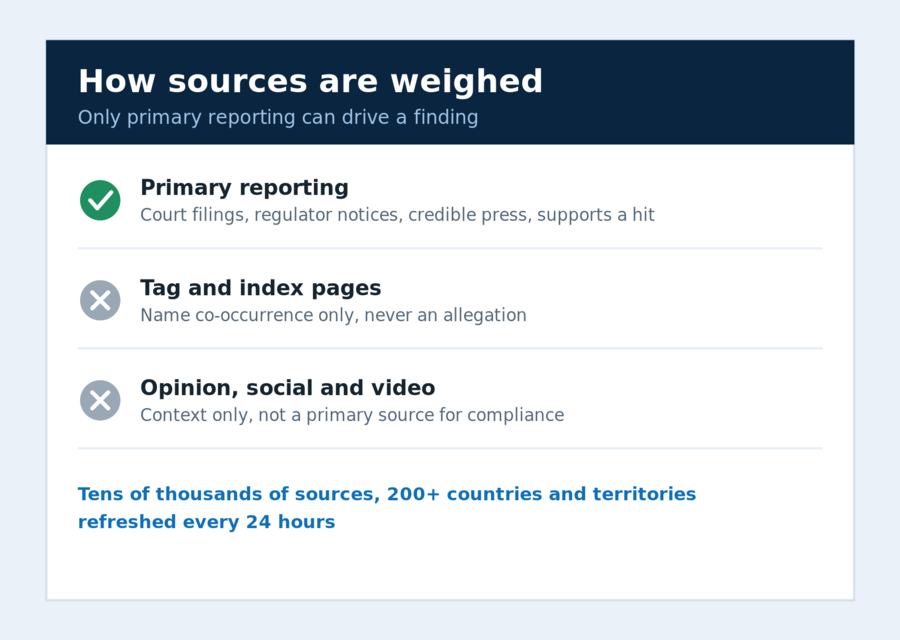
Most negative-news tools bury analysts in false positives; across the industry, more than 90% of screening alerts turn out to be noise. Global RADAR ranks every match by recency, severity, and how directly the subject is involved, then weighs the source behind it: primary reporting can support a finding, while tag pages, opinion and social are treated as context only. Your team works a queue of real risk instead of clearing coincidence.
Types of data monitored
- Global Watch Lists & Sanctions
- Politically Exposed Persons
- Global Negative Media
- Healthcare Exclusions, Disciplinary Actions, Debarments, Licensure
- Criminal Arrest Records; Federal, State, County, City, etc.
Confirm the person, and prove how you know
A shared name is never enough. Global RADAR scores each hit against the subject's identifiers, date of birth, country, and location, and labels it Confirmed, Possible, or Name-Only. Every hit carries the reasoning behind its classification, so when an examiner asks why it was cleared or escalated, the answer is already in the file.
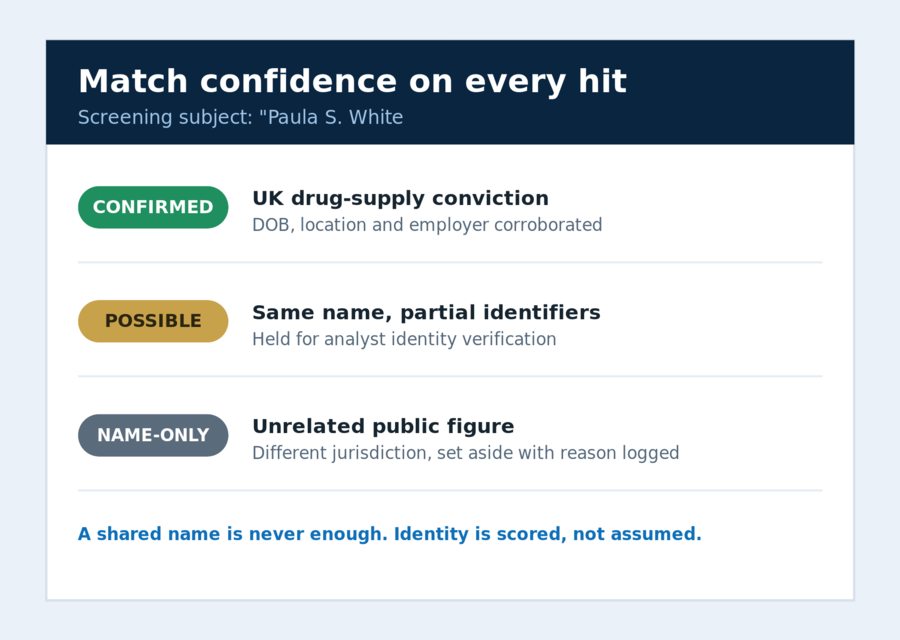
- Match confidence on every hit: Confirmed, Possible, or Name-Only
- Identity scored against date of birth, country, and location, never name alone
- Source type assessed: primary reporting versus aggregator, opinion, or social
- Subject’s role checked: the actor versus a quoted official or bystander
- Audit-ready rationale recorded for every cleared and escalated hit
- Easy API integration and batch upload via XML, CSV, and related formats
Adverse Media Screening FAQ
Every potential match is scored by relevance (recency, severity, and how directly the subject is involved) and by identity confidence. Coincidental mentions, name-only overlaps, and stories where the subject is a bystander rather than the actor are filtered out or flagged before they reach the analyst queue, so reviewers spend their time on hits that carry real risk.
The platform compares the subject's identifiers (date of birth, country, location, and other corroborating detail) against the identifiers in the source, and assigns a match confidence of Confirmed, Possible, or Name-Only. A shared name alone never produces a confirmed match. When the available identifiers are incomplete, the system records that and caps its confidence rather than overstating the result.
The source and its type, the subject's role in the story, the identifiers compared, what matched, what differed, what remained unknown, and the resulting classification in plain language. When an examiner asks why a hit was cleared or escalated, the reasoning is already in the file.
Customers are screened at onboarding and re-screened on a schedule you configure to match each risk tier. New negative news, watch-list changes, and status changes surface against existing relationships without a manual re-run.
Adverse media runs alongside sanctions, PEP, and KYC screening so analysts review one consolidated alert queue rather than reconciling separate tools. Integration is available by API, batch upload, and natively inside Salesforce.
Tens of thousands of media sources across 200+ countries and territories, refreshed every 24 hours, spanning watch lists, sanctions, PEP data, negative media, regulatory and licensure actions, and criminal records.
Every screening returns a decision-ready report: a comprehensive summary of what was found, a risk assessment summary that separates Financial Crime Risk, Conduct Risk, Reputational Risk, and an Overall AML Risk Rating, and suggested next steps so your team knows exactly what to do, each backed by the audit-ready evidence behind every hit.
Adverse media screening is an expected part of customer and enhanced due diligence under the FFIEC BSA/AML Examination Manual, the FinCEN CDD Rule, FATF Recommendations 10 and 12, the EU Anti-Money Laundering Directives, and FCA expectations, and is specifically addressed in Wolfsberg Group guidance on negative-news screening.